Water regulation
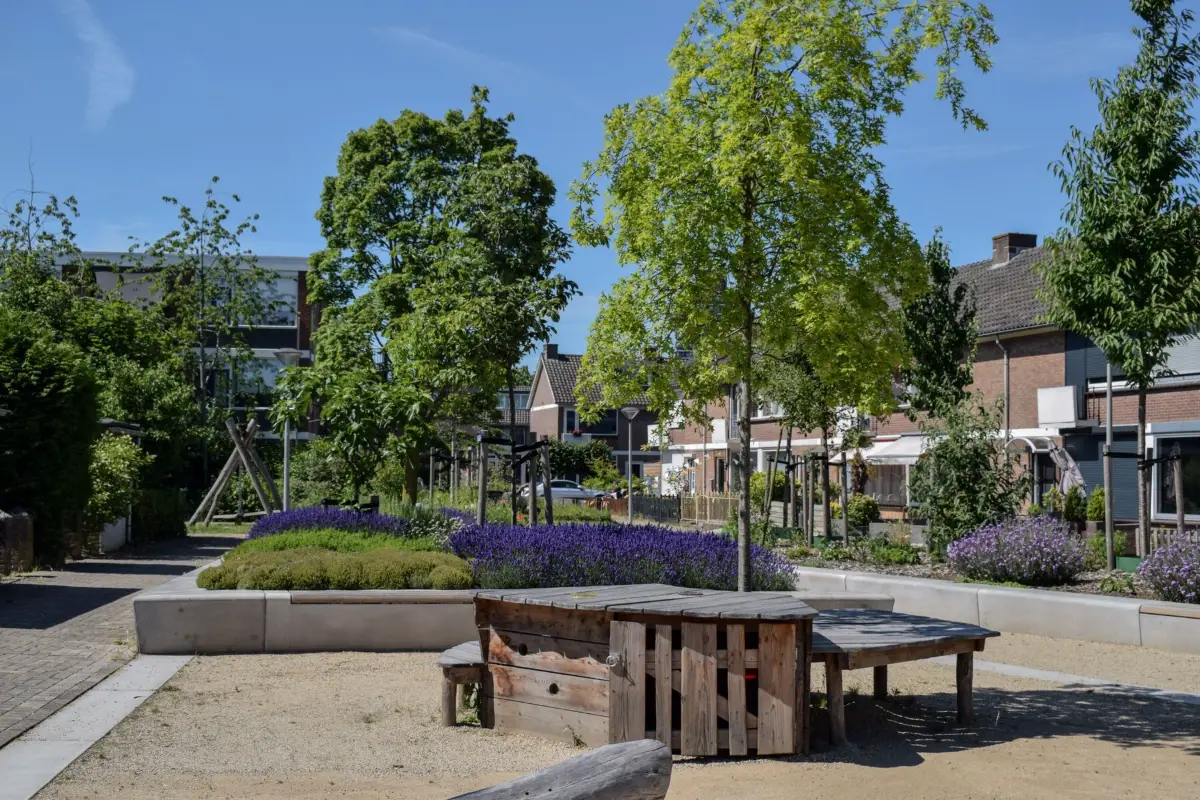
Using green space for water retention, infiltration and more robust urban water management.
INTERREG VI · DEUTSCHLAND–NEDERLAND
For greener, more liveable city centres, with a measurable contribution to climate adaptation and biodiversity.
↓
WHY THIS PROJECT?
Challenges for urban green space
The effects of planting are currently not measurable or predictable enough. As a result, existing methods for (re)designing public green space use too little data, and it often remains unclear which choices are optimal and why.
An integrated solution should reveal the current state of green space, quantify its effects on ecosystem services and show which design is needed to achieve concrete goals for heat stress, soil and groundwater, for example.
WORK PACKAGES
Eight interconnected work packages bring together project organisation, research, digital development and pilots.
Preparation of the joint Dutch-German project and the basis for its implementation.
Coordination of the implementation and cooperation between the project partners.
Goal: understand what keeps trees healthy and which underground conditions are optimal for them.
Result: sensor data and analysis tools that link tree health to soil and water quality and help identify optimal growing conditions.
Goal: develop models that calculate various ecosystem services based on the condition of trees and soil and water quality.
Result: improved and validated models, suitable plant communities and identification of climate-resilient trees.
Goal: develop a knowledge base and joint data hub that connects input data with models for ecosystem services.
Result: a cross-border data hub, knowledge sharing, tools for exchanging data and models, and a digital twin environment.
Goal: develop modules that connect spatial design, calculation of ecosystem services and visualisation.
Result: analysis and design tools, optimal (re)design of public green space, insight into financial benefits and costs, and secure data transfer.
Goal: apply, test and improve the software and knowledge in practice.
Result: data from the pilots, quantification of ecosystem services and tree health, best practices for spatial design and two designs per pilot: a reference design and a climate-adaptive design.
Communication about project progress, knowledge developed and results to partners and external audiences.
The result
PROJECT FRAMEWORK
Priority: A greener programme area
Specific objective: Promoting climate change adaptation and disaster risk prevention and resilience, taking into account ecosystem-based approaches.
The project is developing the first integrated solution for the optimal (re)design of public green space, enabling targeted, measurable improvement of specific ecosystem services.
Using green space for water retention, infiltration and more robust urban water management.
Reducing heat stress with well-considered planting and cooling green structures.
Making the contribution of green space to cleaner air and carbon storage visible.
Strengthening habitats and ecological corridors through targeted design choices.
INNOVATIVE SOLUTIONS
Real-time data reveals the current health and development of urban trees.
Models calculate more realistically how green space contributes to climate adaptation, air quality and biodiversity.
Project data, models and knowledge come together in one shared digital environment.
Design choices are backed by data and linked to concrete societal goals.
Dutch and German pilots test the solutions developed in practice.
ACROSS THE BORDER
Click a marker to see the logo, location and partner page.
Loading map…
PROJECT INFORMATION
ERDF (EFRE / EFRO) €1,273,771.66
MWIKE NRW €230,282.06
Dutch Ministry of Economic Affairs and Climate Policy €163,770.58
Province of Gelderland €100,044.69
State of Lower Saxony €42,668.85
Province of Flevoland €9,135.61
Stedelijk Groen receives €1,819,673.45 in co-funding from the European Union, MWIKE NRW, the State of Lower Saxony, the Dutch Ministry of Economic Affairs and Climate Policy and the provinces of Gelderland and Flevoland.